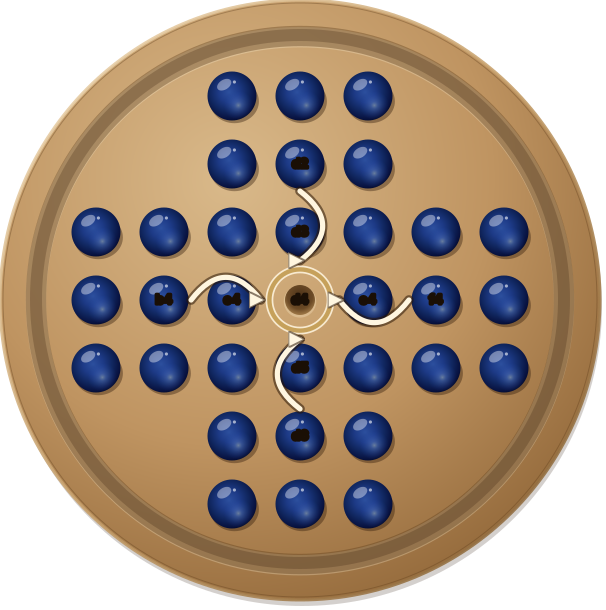
The 33-hole English cross has rows of 3, 3, 7, 7, 7, 3, 3. Empty d4 and finish at d4 in 31 jumps. This is the classic central game.
The English cross, the one everyone means
Say peg solitaire to most people and this is the board they picture: a plus sign of 33 holes with arms three holes wide, thirty-two marbles, and one empty hole right in the middle.
The opening is the neatest in the game. Because the empty hole is the exact centre, your first jump can be made four ways, and all four are the same move turned a quarter turn. So the first decision is not really a decision. The trouble starts on jump two.
The finish is where it began: one marble left, sitting in the centre, after 31 jumps. It is called the central game, and it can be done. That is the whole attraction: the puzzle has an answer, and it is hidden somewhere in those 31 jumps.
Every game starts like this: 33 holes, d4 empty. The first jump is d2 over d3, b4 over c4, f4 over e4 or d6 over d5, and after 31 jumps the last marble has to be back on d4.
How to play the English board
The rows have 3, 3, 7, 7, 7, 3 and 3 holes. Columns run a to g from left to right and rows 1 to 7 from top to bottom, so the centre is d4. Your first jump comes from d2, d6, b4 or f4, over its neighbour, into d4.
Each jump needs two neighbouring marbles in a straight line and an empty hole immediately beyond them. The jumped marble is removed; every jump reduces the count by one.
On square grids, jump horizontally or vertically. On the triangle, use any of the six directions parallel to its three sides. A diagonal on a square grid is never legal.
The marked hole is the required finish. One marble somewhere else is a different result, not a win in this target puzzle. You can undo a jump and explore a different route.
Our counter records individual jumps. Mathematical books sometimes group several jumps by the same marble into one “move”; those totals are not comparable.
Click or tap a marble. If only one jump is possible it happens at once; if there are several, outlined holes show where the marble can land and you pick one. You can also drag a marble onto a hole, or use the keyboard: arrow keys to move, Enter or Space to select and jump, Escape to clear, Ctrl or Cmd with Z to undo.
How to win the English game
Thirty-two marbles means 31 jumps. The target ring sits on d4, and the win is the last marble stopping there. If you end with one marble anywhere else, the game calls it So close: the puzzle is the same size, but the finish was not the one the board asks for.
English board strategy
Know your last jump. Into d4 only four jumps can land, and each needs exactly two marbles left: d2 and d3, d6 and d5, b4 and c4, or f4 and e4. If you are down to two marbles that are not one of those pairs, undo.
Do not strip an arm early. Clearing an outer arm too soon can leave a marble at its base with no neighbour to jump over, and that marble can never leave the board.
When you are close, count. With six marbles left you have exactly five jumps. Say them out loud before you play the first.
The English board solution
Our replay of the default opening shows one verified route, the Bergholt sequence documented by Bell and Beasley in their paper on old solitaire boards, step by step. It is the same 31 jumps every time, so use it to check your own idea rather than to skip the puzzle.
Questions people ask
I have two marbles left and cannot move. What now?
Two marbles can only jump if they are in line with an empty hole beyond them. If they are not, the game is over for that route. Undo a few jumps and try the other branch, or ask for a hint.
Is the English board harder than the French board?
The rules are identical. The English board has 33 holes and 31 jumps against 37 holes and 35 jumps, so it is shorter, and its centre opening is known to work, which the French board’s is not.
Is there a peg solitaire solver?
There is no box where you type a position in, but the game has a solver of its own. The Hint button shows a jump from a route the game has checked can still win. If the search proves the target can no longer be reached, the game says so, which tells you to undo; if it reaches its search limit, the answer is simply unknown. A hint is marked in your result and keeps that game out of your best time.