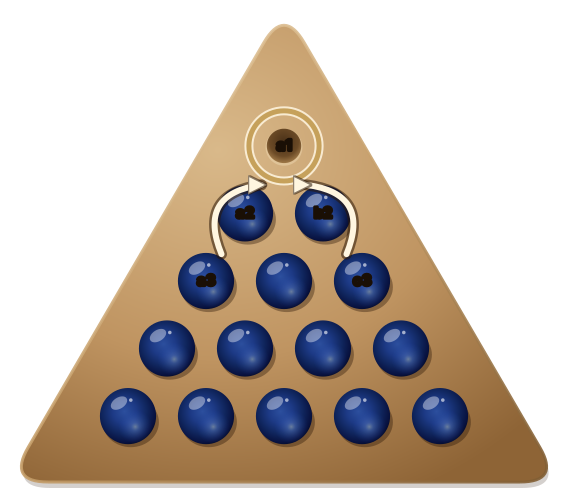
The 15-hole triangle has five rows, from one to five holes. Empty a1 and return the survivor to a1 in 13 jumps. Use all six lattice directions. Starting and finishing on b3 is impossible, and so is a1 to b3.
The triangle, a game for a table
It is the smallest of our boards and the triangle peg game you may have met on a restaurant table: fifteen holes in five rows, fourteen marbles, and an empty hole right at the tip.
There are only two ways to make the first jump, and they are mirror images, so the opening is a choice between left and right. After that the board is small enough that you can hold most of it in your head, which is what makes it so easy to be sure and so easy to be wrong.
It takes thirteen jumps to finish, and the finish is back at the tip you started from.
Every game starts like this: 15 holes, a1 empty. The first jump is a3 over a2 or c3 over b2, and after 13 jumps the last marble has to be back on a1.
How to play the triangle
The rows have 1, 2, 3, 4 and 5 holes and the empty hole starts at a1, at the top. Unlike the other boards the triangle has six jump directions, all parallel to its three sides, so a marble can leap along any of them. Your first jump is a3 over a2 or c3 over b2, landing on a1.
Each jump needs two neighbouring marbles in a straight line and an empty hole immediately beyond them. The jumped marble is removed; every jump reduces the count by one.
On square grids, jump horizontally or vertically. On the triangle, use any of the six directions parallel to its three sides. A diagonal on a square grid is never legal.
The marked hole is the required finish. One marble somewhere else is a different result, not a win in this target puzzle. You can undo a jump and explore a different route.
Our counter records individual jumps. Mathematical books sometimes group several jumps by the same marble into one “move”; those totals are not comparable.
Click or tap a marble. If only one jump is possible it happens at once; if there are several, outlined holes show where the marble can land and you pick one. You can also drag a marble onto a hole, or use the keyboard: arrow keys to move, Enter or Space to select and jump, Escape to clear, Ctrl or Cmd with Z to undo.
How to win the triangle peg game
You win by leaving exactly one marble. Every jump removes one, so fourteen marbles means 13 jumps, no more and no fewer. Here the marked ring is on a1, the hole you emptied at the start, and the win is the last marble returning there.
If you end with two or three marbles left, it is not that you ran out of moves too soon. The marbles that remain have nothing next to them to jump, usually because they were left far apart. Undo a few jumps and ask which marbles you could have brought together.
Triangle strategy
Know your last jump. Only two jumps can land on a1: a3 over a2, or c3 over b2. The last two marbles must be a3 and a2, or c3 and b2.
Use all six directions. Players coming from the square boards forget the triangle’s diagonals and miss half their moves.
Plan on paper. With only 13 jumps you can write the whole route down, then play it and see where it breaks.
The triangle solution
The Solutions page replays one verified 13-jump route from a1 back to a1. There are many; this is one.
Questions people ask
Is this the Cracker Barrel peg game?
It is the same kind of game: a triangle of fifteen holes with fourteen pegs, played by jumping. PegSolitaire.com is an independent site, not affiliated with or endorsed by Cracker Barrel, and the pieces here are marbles with the rules written out in full.
How do I win the triangle peg game?
Leave one marble, on the marked hole. Empty a1, then take the first jump from a3 over a2 or from c3 over b2. Plan the last jump first, since only two pairs of marbles can finish it, and use all six directions. The Solutions page replays one route that works.
Why am I always left with two or three marbles?
Because the marbles left over ended up apart, with no neighbour to jump. Most losing games are decided several jumps before they end, so undo further back than you think you need to.
What is the best result?
One marble left. Restaurant versions often rate you by how many pegs remain, and one is the best score there is.